 Visit Edinburgh Guide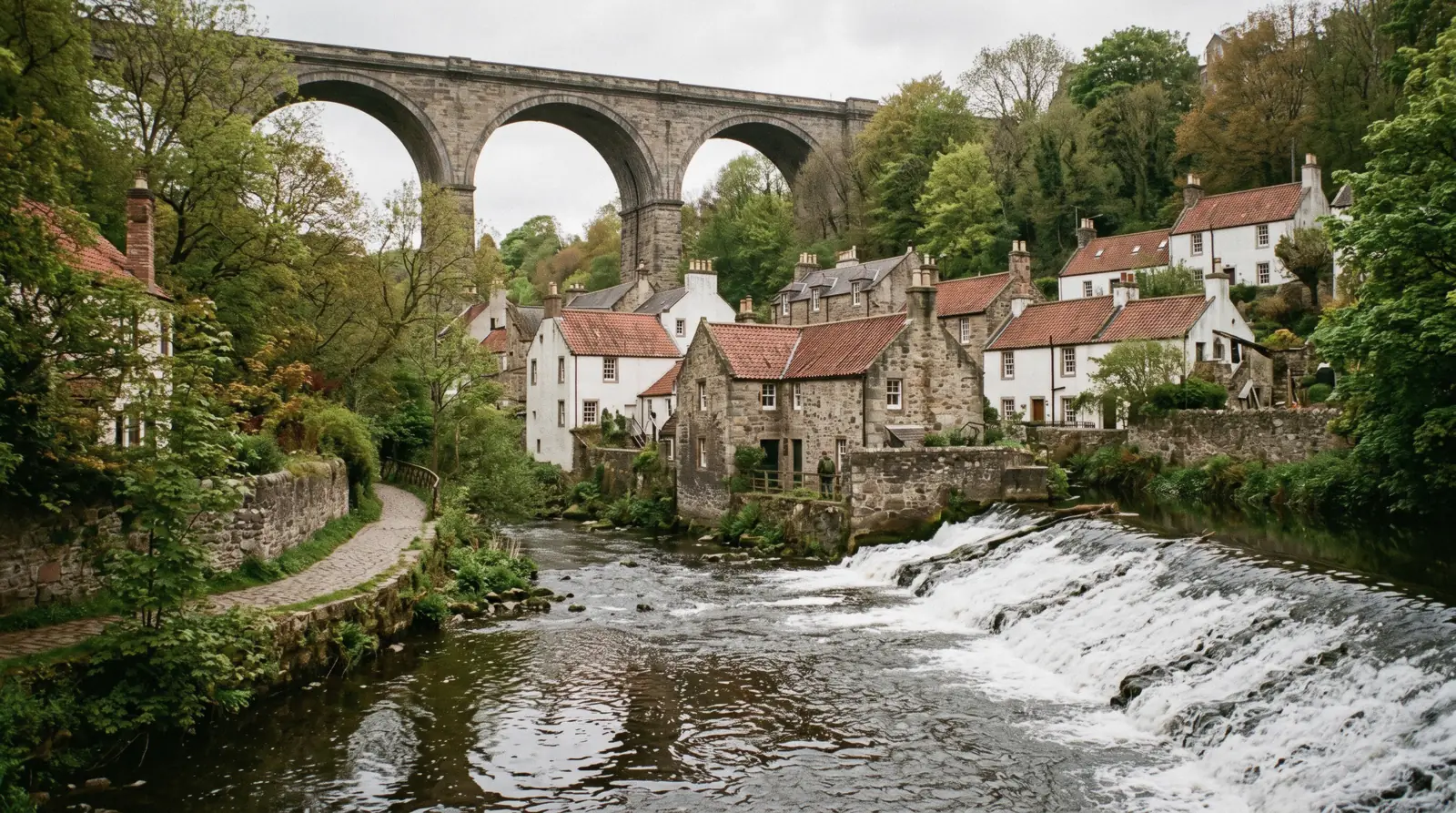
Dean Village
Dean Village Edinburgh is a former milling settlement in a wooded gorge about a mile from Princes Street, and the single most important thing to know about it is that people live there. There is no gate, no ticket and no visitor centre; there is a lane, a river, a courtyard of Victorian workers' flats and a few hundred residents whose front doors open straight onto the cobbles that everybody photographs. It ground Edinburgh's grain for more than 800 years, burned in 1824, sank into poverty by 1960 and was restored from the mid-1970s into one of the most desirable addresses in the city. This page has the history, the walk in from the West End, the Water of Leith Walkway that runs through it, what the Council and the river's own trust actually publish about access — and the plain version of how to behave in someone else's street. It is one stop in our guide to Edinburgh attractions.
Quick answer Free, ten minutes' walk from the West End — and a street of private homes, not an attraction
Dean Village is a free, ungated residential conservation area in a river gorge about a mile west of Princes Street, reached on foot down Bell's Brae from Queensferry Street in roughly fifteen minutes. There is nothing to book and nothing to go inside: every building is a private home or flat. Most people see it in half an hour, and the good version of the visit is to keep walking downstream along the Water of Leith.
Key takeaways
- It is a lived-in street first and a photograph second. The Council's own conservation-area appraisal names "the predominance of residential uses" as its defining feature — what that means in practice is the section to read before you point a camera at a doorway.
- The walk is the point: the Water of Leith Walkway runs straight through, and the stretch on to Stockbridge past St Bernard's Well is about fifteen minutes of the best riverside walking in the city.
- No guided tour we list comes here — the nearest is a three-hour city walk from the Usher Hall at £35 (about $48), which stays in the Old and New Towns. Getting here on your own costs nothing.
- Well Court, the arts-and-crafts courtyard everybody photographs, was built as workers' housing by the owner of The Scotsman; its story is worth two minutes, and its courtyard is somebody's front garden.
Key facts
Opening hours
| The village and its lanes | Public streets — no gate, no barrier, no closing time |
|---|---|
| Water of Leith Walkway | Open at all times; unlit in places |
| Water of Leith Visitor Centre (four miles west, not in the village) | 10:00–16:00 daily |
Closed None — it is a residential neighbourhood. The Visitor Centre publishes no closed day; every building in the village itself is private and never open
Admission
- Adult
- Free — the village, the riverside path and the bridges cost nothing at any hour
- Reduced
- Free
- Free
- Everyone, always. The Trust's printed walkway map is £1 to £2 (about $1.35 to $2.70) at the Visitor Centre, and a PDF version is free to download
Planning it
- Time needed
- Nobody official publishes one. Our routing: 30 to 45 minutes for the village itself, or about an hour and a half if you walk on down the river to Stockbridge
- Book ahead
- Optional — walk-up usually fine
- Address
- Dean Village, Edinburgh EH4 3BE — Bell's Brae, Damside, Hawthornbank Lane and Dean Path, below the Dean Bridge and off Queensferry Street
Nobody sells a ticket to Dean Village, so this sets out the only things connected to it that cost anything at all: a paper map of the river path, and two guided walks that go elsewhere in the city. The walk prices are the operators' own, listed in pounds on GetYourGuide and read on 30 August 2026.
One question decides the row: are you walking the village, or buying a guided walk that goes somewhere else? Nothing here charges admission, and none of the walks listed comes to Dean Village.
| What | Price | What it covers | Booking | Book |
|---|---|---|---|---|
| Walk into the village yourselfThe right choice for everyone; the lanes and bridges cost nothing at any hour | Free | The lanes, the bridges, the riverbank and the outside of Well Court — nothing indoors | None — no gate, no ticket office, no hours | Official site |
| Water of Leith Walkway, all 13 milesFor walkers following the river well beyond the village | Free; printed map £1–£2 (about $1.35–$2.70) | The river path from Balerno to Leith, passing through the village | None; the PDF map is a free download | Official site |
| Water of Leith Visitor Centre, SlatefordFor anyone curious about the river itself, four miles west of here | Free | The exhibition about the river — four miles west of here, not in the village | None; daily 10:00–16:00 | Official site |
| Three-hour guided city walkFor a wider city walk, listed for comparison rather than for the village | £35 (about $48) | Nineteen stops from the Usher Hall to the Scott Monument — it does not come here | Free up to 24 hours before | Check Availability |
| Old Town history and tales walk, 2 hoursFor the medieval half of the city, a mile east of the village | £18 (about $24) | The medieval half of the city on foot, a mile east of the village | Free up to 24 hours before | Check Availability |
The three official rows are plain links with no tracking on them. The two walk rows are affiliate links to GetYourGuide: the prices are the operators' own, we take a commission if you book through them, and it costs you nothing extra. Both are listed here for comparison, not because they visit Dean Village — none of the walks we list does. Prices and ratings read on 30 August 2026. The official rows link to Edinburgh World Heritage and the Water of Leith Conservation Trust with nothing added to the URLs, and dollar figures are at £1 = $1.36.
Guided walks, and why none of them comes here
Worth saying plainly before you look: no tour in this catalogue includes Dean Village. There is no ticket to resell, no queue to skip and no operator with permission to bring a group into a residential lane, so the walking-tour market has simply left it alone — which is part of why it stays quiet. These two are the city walks people book instead, listed so you can see what a guide buys elsewhere. Prices, ratings and review counts are the operators' own, read on 30 August 2026.
 from £35
Edinburgh: 3-Hour Guided Walking Tour
Three hours and nineteen stops, from Usher Hall through the Grassmarket and Royal Mile to the Scott Monument, led by historians. You pass the castle from outside; no entry is included.
Check Availability from £18
Edinburgh: Old Town History and Tales Walking Tour
Two hours through the UNESCO Old Town covering Mercat Cross, St Giles' and the Grassmarket, plus the Harry Potter locations. Ends in the centre near bars and transport; English only.
Check AvailabilityPrices, ratings and details are the platform's own. Pound figures are the listed prices. The platform bills in your account's currency.
Eight hundred years of milling, one fire, and a slum that became an address
The village is older than almost everything else you will see in Edinburgh, and its whole shape — the tall mill buildings, the narrow lanes, the bridge at the bottom of two steep braes — comes from grinding grain. Dates below are from Edinburgh World Heritage and Wikipedia, which disagree in one place; we say so where they do.
The name comes from dene, an old word for a deep valley, and the settlement was called the Water of Leith Village long before it was called Dean. The timeline below is drawn from Wikipedia's account and from Edinburgh World Heritage's own page, with the source named on every row.
| When | What happened | What is left to see | Source |
|---|---|---|---|
| c. 1145 | A mill of the Dene granted to Holyrood Abbey | The gorge and the weirs that made milling possible | Wikipedia |
| c. 1675 | The Baxters build their Tolbooth in the village | The old Tolbooth on Bell's Brae, altered in 1900 by Robert Lorimer | Wikipedia |
| Early 18th century | The single-arch bridge at the foot of Bell's Brae | Still the crossing in the middle of the village | Wikipedia |
| November 1824 | Fire destroys mills and warehouses | The gap in the built record either side of the river | Edinburgh World Heritage |
| 1831–33 | Telford's Dean Bridge carries the road over the top | Four arches, 106 feet above the water, the view from below | Wikipedia |
| 1880s | Well Court built as workers' housing | The courtyard, the tower and the clock | Edinburgh World Heritage |
| From the mid-1970s | Restoration into flats and houses | A residential conservation area with about 400 residents' cars to park | Wikipedia |
The milling village and its charter
Wikipedia's account traces the first mention of the Dene to King David I's founding charter of Holyrood Abbey, usually dated around 1145, in which he granted one of his mills there to the abbey — and it records eleven working mills in the gorge at the village's peak, driven by the same fast water you can still hear from the footbridge. Edinburgh World Heritage's own page dates the milling community to the 12th century and ties it to the Incorporation of Baxters, Edinburgh's bakers, whose Tolbooth was built here around 1675 and altered in 1900 by Robert Lorimer for St Mary's Cathedral Mission.
The end came from three directions
The end of it came from three directions. A great fire in November 1824 destroyed mills, warehouses and other buildings; larger, more modern flour mills opened down at Leith and took the trade; and in 1831–32 Thomas Telford's Dean Bridge was thrown across the top of the gorge, carrying the Queensferry road at 106 feet above the water on four arches spanning over 400 feet, so that traffic between the city and the west could bypass the village altogether. By 1887 the Belford Bridge finished the job. The village went from a working place to a place you drove over.
What followed was a century of decay — Wikipedia puts the low point at around 1960 — and then, from the mid-1970s, a slow conversion of workers' cottages, warehouses and mill buildings into flats. That is what you are walking through: not a preserved village, but a restored one, with a resident population and a full set of wheelie bins.
Why the gorge is protected, and by whom
Dean Village sits inside Edinburgh's UNESCO World Heritage Site — property 728, inscribed in 1995 and covering 443 hectares. UNESCO's own description of how the site is protected names four conservation areas that between them cover the majority of the property: Old Town, New Town, West End and Dean Village. Around 75% of buildings within the property are category A, B or C listed, and the setting is protected by a Skyline Policy adopted by the Council.
The local layer is the Dean conservation area, whose character appraisal the City of Edinburgh Council approved on 2 October 2003. The Council's summary of it names, in this order, "the distinctive village character of the streetscape within Dean Village, the heritage of high quality buildings, the limited range of building materials, the predominance of residential uses, and the importance of the Water of Leith". That fourth item is the one visitors need: the Council's own designation says this is a place where people live.
Visiting a street where people live: what is a rule and what is our advice
Nobody sells tickets here, so nobody sets visiting rules either — which leaves a gap that this page will fill honestly. Below, anything a public body actually publishes is marked as such; everything else is our own advice, and is labelled that way.
Start with what is documented. The City of Edinburgh Council designates Dean as a conservation area whose defining features include "the predominance of residential uses" (character appraisal approved 2 October 2003). The Water of Leith Conservation Trust, which champions the river path through the village, backs the Paths for Everyone code of conduct: the route is shared by walkers, cyclists, runners and dog walkers, and the Trust's stated aim is that everyone can use it "in safety and comfort". Those are the only two published statements about behaviour that we could find from an authority with any standing here. There is no council leaflet on visiting Dean Village, no code of conduct posted by a residents' association that we could source, and no visitor management scheme of any kind.
So the rest of this is ours, and we would rather write it than pretend a body published it.
What we would ask you to do here
- No doorway photography. The picturesque doors on Damside and around Well Court are front doors. Photograph the street, the river and the roofline; do not frame a doorway a person is about to walk out of, and never photograph through a window. This is our advice, not a rule — which is exactly why it matters that visitors follow it.
- Drones need permission, and that part is a rule. Under the City of Edinburgh Council's own published drone guidance, you need the landowner's permission to take off from or land on council land: parks and green spaces are handled by [email protected], roads by [email protected], and any filming permit through [email protected]. Everything you fly must also comply with the Civil Aviation Authority's Drone Code. Over a dense residential conservation area with a gorge and high bridges, the honest answer is: not here, not casually.
- The footbridge is single file. The metal bridge over the Water of Leith at the bottom of Hawthornbank Lane is the best view in the village and the narrowest point in it. Take the photograph, step off the bridge, then look at it on your screen. People cross this to get to work.
- The courtyards are gardens. Well Court's courtyard, the drying greens and the stairs off Damside belong to the flats around them. The whole composition is visible from the public lanes and from the bridge — you lose nothing by staying on them.
- Come early, and keep the noise down. Our reading, not an official figure: the village is effectively empty of visitors before 09:00 and busiest from about 10:00 to 16:00. Voices carry off stone and water in a gorge in a way they do not in a street.
- Take your litter out with you. There is no bin, no public toilet and no visitor infrastructure of any kind in the village, as the paragraph on what is not here sets out.
What is not here, which surprises people
We checked for a café, a shop, a public toilet and a visitor centre with an address inside the village, and found none of them publishing one. There is no ticket office, no information point, no bin bank sized for visitors and nowhere to buy a bottle of water. The nearest facilities are up the hill at the West End or downstream in Stockbridge, each about fifteen minutes on foot.
The one official interpretation of the river is the Water of Leith Visitor Centre at 24 Lanark Road, EH14 1TQ — free, open daily 10:00 to 16:00, wheelchair-accessible throughout, family- and dog-friendly. Read the address before you set off: it is four miles west of the city centre, at Slateford, and it is not in Dean Village. People make that mistake regularly.
Parking: don't. The surrounding streets are controlled residential parking and the village's own lanes are barely wide enough for a delivery van. Every approach in getting here is on foot.
Well Court: the courtyard in every photograph, and who built it
The red sandstone block with the tower and the clock, on the north bank, is the single most recognisable building in the village. It was social housing, and it came with conditions.
Well Court was commissioned by Sir John Findlay, owner of The Scotsman, and designed by Sydney Mitchell as housing for local workers — flats around a large courtyard, with a communal hall. Edinburgh World Heritage calls it a rare arts-and-crafts building in Edinburgh and among Mitchell's finest work. Tenancy came with strings: tenants were expected to keep to standards of behaviour and to attend church on Sundays, which tells you as much about Victorian philanthropy as the architecture does.
The date is not settled between two pages of the same organisation. Edinburgh World Heritage's Dean Village page says Well Court was constructed in 1880; its own page devoted to Well Court says the scheme was commissioned in the 1880s and completed in 1886. Both were live when we read them on 30 August 2026. Take the 1880s and do not repeat a single year as though it were certain.
It was restored in 2007 in a programme supported by Edinburgh World Heritage, using traditional materials throughout — sandstone, roof tiles, glazing, reproduced original paint colours — and the weathercock and clock faces were re-gilded. That gilding is why the tower reads so brightly in photographs taken since.
One practical note that follows from all of the above: Well Court is a block of flats. There is no public access to the courtyard, the hall or the stair. The view that everybody takes is from the far bank of the river and from the footbridge, which is public and free, and it is a better composition than anything you would get from inside. Because Well Court itself is closed to visitors, the stories behind it come through most clearly on guided tours of Edinburgh that include Dean Village on their route.
The Water of Leith Walkway: the walk that makes the visit worth it
The village on its own is a twenty-minute stop. The river path through it is thirteen miles long, and the two stretches either side of Dean Village are the best of them. All figures below are the Water of Leith Conservation Trust's own, read on 30 August 2026.
The Trust's own section mileages for the Water of Leith Walkway are below. The two short walks from Dean Village are ours, measured on the path.
| Section | Distance | Time | Whose figure |
|---|---|---|---|
| Balerno to Slateford | 5 miles | 2 hours | Water of Leith Conservation Trust |
| Slateford to Leith | 7.5 miles | 3 hours | Water of Leith Conservation Trust |
| Roseburn to Stockbridge (through Dean Village) | About 2 miles | 45 minutes | Water of Leith Conservation Trust |
| Stockbridge to Leith | About 3.5 miles | 1 hour 20 minutes | Water of Leith Conservation Trust |
| Dean Village to St Bernard's Well | Roughly half a mile | About 10 minutes | Our estimate on the path |
| Dean Village to Stockbridge | Roughly three quarters of a mile | About 15 minutes | Our estimate on the path |
The walkway runs 13 miles from Balerno to Leith, was completed in 2002 with Millennium Project funding and is managed by the City of Edinburgh Council — though Wikipedia dates the path through this stretch to 1983, so the route here is older than the completed whole. It passes Colinton Village, Craiglockhart Dell, the Union Canal, Saughton Gardens, Murrayfield Stadium, the Scottish National Gallery of Modern Art, Dean Village, Stockbridge, the Royal Botanic Garden and Leith. The Trust describes it as suitable for cycling and partly accessible by wheelchair and on horseback — 'partly' is doing real work in that sentence, and the section through the gorge has steps and narrow stretches.
One live closure to know about: the walkway is closed between Waulkmill Loan and Currie Kirk because of a dangerous bridge, with a diversion along Lanark Road. That is at the far Balerno end, eight miles upstream of Dean Village, and it does not affect anything on this page — but if you are planning the full length, plan around it.
Which way to walk it
Downstream, always. Go west or uphill and you are climbing out of a gorge into a main road; go east and downstream and the path stays beside the water, passes under the Dean Bridge, reaches St Bernard's Well in about ten minutes and delivers you into Stockbridge in about fifteen, where there are cafés, a Sunday market and a bus back into town.
Upstream is the other good option if you want a museum at the end of it: about fifteen minutes on the path brings you to the Scottish National Gallery of Modern Art, whose grounds sit above the river. Both directions are signed with the Trust's own waymarks.
The printed Trust map is £1 to £2 (about $1.35 to $2.70) at the Visitor Centre or by post within the UK, and a PDF version is free to download from the Trust's site — which is the version worth having on your phone before you lose signal in the gorge.
St Bernard's Well: the temple on the riverbank ten minutes downstream
A domed classical rotunda standing over a mineral spring, between Dean Village and Stockbridge, and the natural turning point of the short walk. The facts here are the City of Edinburgh Council's own, from its Culture Edinburgh pages, read on 30 August 2026.
The Council dates the structure to the 1790s and credits its design to the Scottish painter Alexander Nasmyth. Its domed ceiling is supported by ten columns and covers a statue of Hygeia, the Greek goddess of health; the spring beneath was valued for its supposed medicinal water from the middle of the eighteenth century until it closed in 1940. The Council's own map reference for it is 2 Clarendon Crescent, EH4 1PT, on the north bank of the Water of Leith.
What the Council does not publish is any opening arrangement. There are no hours, no admission, no season and no contact for access on its page — so the honest version is that the well is a monument you walk up to and look at, that the interior is normally locked, and that if you have read somewhere that it opens on certain days, no official page confirms it. Treat the outside as the visit.
It is also the reason to keep walking. The path from the village to the well runs under the Dean Bridge and along the water for about ten minutes, and the rotunda appears above you on the bank with steps up to it. From there it is another five minutes into Stockbridge.
How to get to Dean Village, and which way in
It is about a mile from Princes Street and every sensible approach is on foot. The village sits at the bottom of a gorge, so all of them end in a descent. Walking times are our own estimates; nobody official publishes any.
The standard way in is down Queensferry Street from the West End, then down Bell's Brae, the steep lane that drops off the road just before the Dean Bridge.
| Coming from | How | Time (our estimate) | Where it puts you |
|---|---|---|---|
| West end of Princes Street | Queensferry Street, then down Bell's Brae | About 15 minutes | The old bridge in the middle of the village |
| Haymarket station | Up Belford Road on foot | About 15 minutes | The western entrance, past the gallery |
| Scottish National Gallery of Modern Art | Downstream on the Water of Leith Walkway | About 15 minutes | The riverside path into the village |
| Stockbridge | Upstream on the walkway, past St Bernard's Well | About 15 minutes | The footbridge at Hawthornbank Lane |
| Waverley station | Along Princes Street, then as above | About 25 minutes | The old bridge, via the West End |
About fifteen minutes from Princes Street's west end, and the lane delivers you straight onto the old bridge in the middle of the village, with Well Court in front of you. Coming from Haymarket, walk up Belford Road instead — about the same time, and it brings you in from the west past the gallery.
The better arrival, if you have twenty minutes to spend, is on the river itself: pick up the Water of Leith Walkway at the Scottish National Gallery of Modern Art and follow it downstream, so that the village appears below the trees rather than at the end of a road.
There is no tram stop and no bus stop in the village — the gorge is too tight for either. Services run along Queensferry Road on the bridge high above it and around the West End, and a Lothian city single is £2.40 (about $3.30), a day ticket £6.00 (about $8.20), with contactless capping at £5.70 (about $7.75) through the operator's own Tap Tap Cap; how the tickets and caps work has the rest. In practice, walking here from the West End is faster than waiting for anything.
Accessibility, honestly
Every approach involves a significant descent and the same climb back out. Bell's Brae and Dean Path are steep; the lanes are cobbled and uneven; the riverside path has steps in places and narrows to a single line of walkers at the footbridge. The Trust describes the walkway overall as "partly accessible by wheelchair", and the gorge section is one of the parts where that qualification bites.
If steps and gradients are a problem, the gentlest version is to come in from the Belford Road side, look at the village from the bridge at the bottom, and go back the way you came rather than attempting the loop up Dean Path. Nobody publishes a step-free route through the village, and we are not going to invent one.
Dean Village map: the ways in, the bridges and the walk downstream
The village core, the two bridges, the lane down from Queensferry Street and the riverside route on to St Bernard's Well and Stockbridge. Pin positions are approximate to within a few metres and are taken from published addresses and the line of the walkway.
Next stop from Dean Village
Walking times are our estimates, measured from the old bridge in the middle of the village.
Stockbridge
The obvious continuation: follow the water past St Bernard's Well and you arrive among cafés and independent shops. The Stockbridge page has the Sunday market hours and what the neighbourhood is for.
15 min walk downstreamThe New Town
Back up Bell's Brae and you are in the Georgian grid within a few minutes. The New Town page covers the crescents, the squares and what is worth going inside.
15 min walk uphillThe Scott Monument
The climbable spire at the far end of Princes Street Gardens. The Scott Monument page has the ticket price, the step count and the hours.
22 min walk east along Princes StreetDean Village questions
Is Dean Village in Edinburgh worth visiting?
Yes, if you treat it as a twenty-minute stop at the start of a river walk rather than an attraction in its own right. There is nothing to go inside and nothing to buy — the reward is a millers' village in a wooded gorge a mile from Princes Street, and the path that runs through it. Walk on downstream to St Bernard's Well and Stockbridge and the half hour becomes the best ninety minutes in the city; the walkway section has the distances.
Why is Dean Village so famous?
For its looks and its improbability: tall mill buildings, red pantiles and a fast river, inside a UNESCO World Heritage Site and ten minutes from the shops. It milled Edinburgh's grain for more than 800 years — Wikipedia counts eleven working mills at its peak — burned in 1824, decayed until about 1960, and was restored from the mid-1970s. The photograph everyone takes is of Well Court, the 1880s workers' housing with the clock tower.
How long does it take to walk through Dean Village?
Five minutes to cross it, and 30 to 45 minutes to see it properly, including the footbridge, Well Court from the far bank and the view up at the Dean Bridge — those are our estimates, since nobody official publishes one. Add about 15 minutes each way if you continue on the Water of Leith Walkway to Stockbridge, which is what we would do.
How far is Dean Village from Edinburgh city centre?
About a mile from the west end of Princes Street, which is roughly 15 minutes on foot down Queensferry Street and then Bell's Brae. There is no tram or bus stop in the village itself — the gorge is too narrow — so every arrival is a walk. The directions section compares the five approaches and says which one gives the best first view.
Can you go inside Well Court?
No. Well Court is a block of private flats built in the 1880s as workers' housing and restored in 2007 with Edinburgh World Heritage's support; its courtyard, hall and stairs are residents' property. Everything worth photographing is visible from the public riverbank and the footbridge, which is where the familiar view is taken from. The Well Court section has the architect, the patron and the date the two sources disagree about.
Is there anywhere to eat, or a toilet, in Dean Village?
No. We looked for a café, a shop, a public toilet and an information point publishing an address inside the village, and found none. The nearest facilities are at the West End or in Stockbridge, each about 15 minutes away on foot. The Water of Leith Visitor Centre is free and open daily 10:00–16:00 but sits four miles west at Slateford, not here — the practical section spells that out, because people go to the wrong one.
Can you fly a drone over Dean Village?
Not without permission. The City of Edinburgh Council's published drone guidance requires the landowner's consent to take off from or land on council land — parks and green spaces through [email protected], roads through [email protected], filming through [email protected] — and everything you fly must comply with the Civil Aviation Authority's Drone Code. Over a dense residential conservation area in a gorge, our advice is simply not to.
The version of this that works
Go early and go downstream. Leave the West End at about half past eight, walk down Queensferry Street and Bell's Brae, and you will have the old bridge, the footbridge and the view of Well Court to yourself for half an hour — quiet enough to notice that the loudest thing in the gorge is the weir.
Then keep walking. Pick up the Water of Leith Walkway heading east, pass under Telford's bridge, stop at St Bernard's Well after about ten minutes, and arrive in Stockbridge fifteen minutes later for breakfast, which is where the coffee and the toilets are. That sequence turns a photogenic dead end into a proper morning, and it is free from start to finish.
The two things to get right are timing and manners. After 10:00 in summer the footbridge queues, and the village stops feeling like a village. And every door you pass belongs to somebody — the etiquette section sets out what is a rule and what is our advice, and the difference between the two is the honest part.
If you want a guide for the rest of the day, the three-hour city walk covers the Old and New Towns for £35 (about $48), and none of the walks we list comes here, which is not an accident. The rest of the city, with the same hours-price-map treatment on every page, starts from our guide to the best things to do in Edinburgh.
Dean Village and the Water of Leith on film
Three walk-throughs that show the scale of the place — how small the village core is, how close the river runs to the doors, and what the path downstream actually looks like. Ids copied from our verified list, embedded without cookies.
Edinburgh, Dean Village, Water of Leith Walkway — walking tour
The village and the path in one continuous walk, which is the sequence this page recommends.
Video: Marlon & Mai Walking ToursA complete 4K walk through Dean Village and the Water of Leith
Slow and unedited, so you can see how narrow the lanes and the footbridge really are before you arrive.
Video: Doctor AwayWater of Leith Walkway: Dean Village to St Bernard Bridge
Exactly the ten-to-fifteen-minute stretch downstream to St Bernard's Well and Stockbridge.
Video: The 5k Tourist: Anna's AdventuresThird-party videos. Neither the channels nor the videos are connected to this site.
Prices, hours and terms are set by the venue or operator and confirmed at checkout.
We may earn a commission if you book through one of our links, at no extra cost to you. Full affiliate disclosure