 Visit Edinburgh Guide
Edinburgh Neighbourhoods
Edinburgh neighbourhoods are not a scatter of districts on a flat map: they are a ridge, a drained valley, a Georgian grid and a port, laid out in that order and reached in that order on foot. This page compares the seven areas a visitor actually uses — Old Town, New Town, Leith, Stockbridge, the Grassmarket, Dean Village and Victoria Street — on the four things that decide between them: how loud they are after dark, how far the walk back to the ridge is, what is still open in the evening, and who each one suits. Each entry is three lines and a link to the full guide; the wider trip starts with things to do in Edinburgh.
Quick answer Seven areas, what separates them, which one to walk first
Edinburgh's visitor city is small enough to walk end to end. The medieval Old Town runs along one high ridge from the castle to Holyrood; the Georgian New Town is a planned grid on the plain to the north, and the two are linked across the Waverley valley by North Bridge and the Mound. UNESCO inscribed the pair together in 1995 as a single 443-hectare property, and about 75% of the buildings inside it are category A, B or C listed. Everything else a visitor uses — the Grassmarket, Victoria Street, Stockbridge, Dean Village and Leith — hangs off those two.
Key takeaways
- Walk the ridge first and the grid second: the Old Town holds the castle, the closes and the free museums, and a two-hour history and tales walk at £18 (about $24.48) is the cheapest way to have it explained on the ground
- Two areas are places, not places to sleep: Dean Village is a lived-in conservation area with no ticket, no hours and no facilities at all, and Victoria Street takes about 20 minutes to walk end to end at both levels
- The market days are the trap — Grassmarket trades Saturday 10:00 to 17:00 and Stockbridge Sunday 10:00 to 16:00, the same operator running opposite days, so a Saturday in Stockbridge finds a quiet street
- Leith is the one area that needs transport: two miles north, about 20 minutes by tram or bus on the yacht's own figure, and the district where a distillery tour and tasting at £25 (about $34) is the cheapest guided thing on offer
The seven areas compared
The columns are the four things that decide where a visitor spends an evening: night noise, the walk back up to the ridge, what is still trading when the museums shut, and who the area suits. Fares come from lothianbuses.com and edinburghtrams.com, revised on 22 February 2026 and read on 30 August 2026.
| Area | Noise after dark | Walk to the ridge | What is open in the evening | Who it suits |
|---|---|---|---|---|
| Old Town | Loud — pubs, ghost walks and, in August, the Fringe until the small hours | You are on it | Pubs, ghost tours and the closes; the museums shut at 17:00 | First-timers, and anyone who wants the castle out of the window |
| Grassmarket | Loudest of the seven at the weekend, to pub closing time | Two minutes up Victoria Street or Candlemaker Row | A wall of pubs; the free Saturday market packs up at 17:00 | Drinkers, and people who want the ridge above them rather than under them |
| Victoria Street | Quiet once the shops close; the noise is downhill in the square | Inside the Old Town, one flight up to George IV Bridge | Almost nothing — this is a shopping street with a roofed arcade above it | Photographers and shoppers, for about 20 minutes each way |
| New Town | Restaurant volume, not pub volume | About 15 minutes, downhill out and uphill back | Restaurants, bars and the theatres; both national galleries close at 17:00 | Repeat visitors, and anyone who wants to sleep |
| Stockbridge | Village quiet — a handful of pubs, no late strip | About 15 minutes downhill from Princes Street on the tourist board's own figure, so roughly 25 back to the ridge (our estimate) | Neighbourhood restaurants and pubs; the Sunday market ends at 16:00 | Slow mornings, riverside walking, families |
| Dean Village | Silent — it is somebody's street | About 15 minutes down Bell's Brae from Queensferry Street, uphill back | Nothing. No shop, no café, no visitor facility of any kind | Half an hour with a camera, on the way to somewhere else |
| Leith | Busy from about 19:00 on Friday and Saturday around the Shore, quiet by midnight | Two miles: about 20 minutes by tram or bus, about 40 minutes walking up Leith Walk (our estimate from the distance) | The best eating in the city, three starred kitchens inside 400 metres, plus the port bars | Dinner, and anyone who would rather spend the money on food than on a view |
Noise is our own reading of when each street is busy, not a measured figure — the City of Edinburgh Council publishes no footfall or noise data for these areas, and we checked for one on 30 August 2026 before writing this column. Walking figures are the operators' or the tourist board's own where one exists, and are flagged as our estimates where none does. Dollar figures are approximations at £1 = $1.36 and are never what you are charged.
The seven area guides, numbered to the map
Grouped by which side of the Waverley valley they sit on, and numbered to the pins below. Sort with the chips, or filter by side of the valley. Three lines each and a link — the full guide to every area is its own page.
The ridge and the valley below it
-
Old Town
District Free to walkHalf a day
The medieval ridge: castle at the top, Holyrood at the bottom, and a fishbone of closes and wynds falling away from the High Street on both sides. Four of the best things on it cost nothing, and the two that need a date locked in are the castle and the sealed closes under the City Chambers.
Tip: Walk it downhill from the esplanade, not uphill from the palace — the gradient decides how much of it you actually see.
-
Grassmarket
Square Free to walk1 hour
A broad open square in a valley at the south-west foot of the castle rock, and the city's old public execution ground — the gallows site is marked in dark paving beside the Covenanters' Memorial. A free market trades here every Saturday, 10:00 to 17:00, all year.
Tip: Weekday morning for the empty square and the castle above it; Saturday for the market; Friday night for none of that.
-
Victoria Street
Street Free to walk20 minutes
A curved shopping street of 1829–1834, built by Thomas Hamilton to replace the steep West Bow, with a second level — Victoria Terrace — running above the shopfronts on the north side. No gate, no ticket, no opening time, and the upper arcade is roofed, which matters here more often than it should.
Tip: Before 09:00 or after 18:00 for the photograph; the shops themselves keep ordinary retail hours.
North of the valley: the grid and the river
-
New Town
District Free to walkHalf a day
A Georgian grid begun in 1767: three main streets running east to west between two garden squares, with Princes Street facing the castle across the valley. Both national galleries inside it are free and open daily 10:00 to 17:00, and the one paid climb is the Scott Monument.
Tip: The Scott Monument cannot be pre-booked at all and closes every day from 12:30 to 13:45 — plan around that, not through it.
-
Stockbridge
District Free to walkHalf a day
A village-scaled district on the Water of Leith immediately north-west of the grid, which Scotland's national tourist board calls a short 15-minute downhill walk from Princes Street. Nothing here charges admission: the draw is the Sunday market, the independent shops on St Stephen Street and Raeburn Place, the Colonies and the riverside path.
Tip: Sunday only for the market, 10:00 to 16:00 — the same operator's Saturday market is in the Grassmarket, on the other side of the city.
-
Dean Village
Conservation area Free to walk30 minutes
A former milling hamlet in a river gorge about a mile west of Princes Street, reached down Bell's Brae in roughly fifteen minutes. UNESCO names the Dean Village Conservation Area as one of four that between them cover the majority of the World Heritage property. Every building in it is a private home.
Tip: Keep walking downstream instead of turning back — the stretch on to Stockbridge past St Bernard's Well is the best of the walkway.
Down at the water
-
Leith
Port district Free to walkHalf a day and dinner
Edinburgh's port at the mouth of the Water of Leith, two miles north of the ridge, a separate town until 1920 and still not behaving like the rest of the city. The tram has run through it to Newhaven since 7 June 2023, and three of Scotland's Michelin-starred kitchens stand within 400 metres of each other on and around the Shore.
Tip: Go for dinner rather than for daylight: the Shore is quiet at lunchtime and comes alive from about 19:00.
Numbers match the list — tap a pin for the guide.
Coordinates are the Wikidata centroids for each area, or the centre of the street where the area is a street. Distances between pins are straight lines, not walking routes — the walking figures in this page's table are the source we trust.
The walks that stitch the areas together
Four bookable things that cross more than one of these districts, so they belong on this page rather than on any single area guide. Prices are the operator's own in pounds as listed on GetYourGuide on 30 August 2026; ratings and review counts are the platform's. Every card links to the operator's page, where the date calendar shows what is still open.
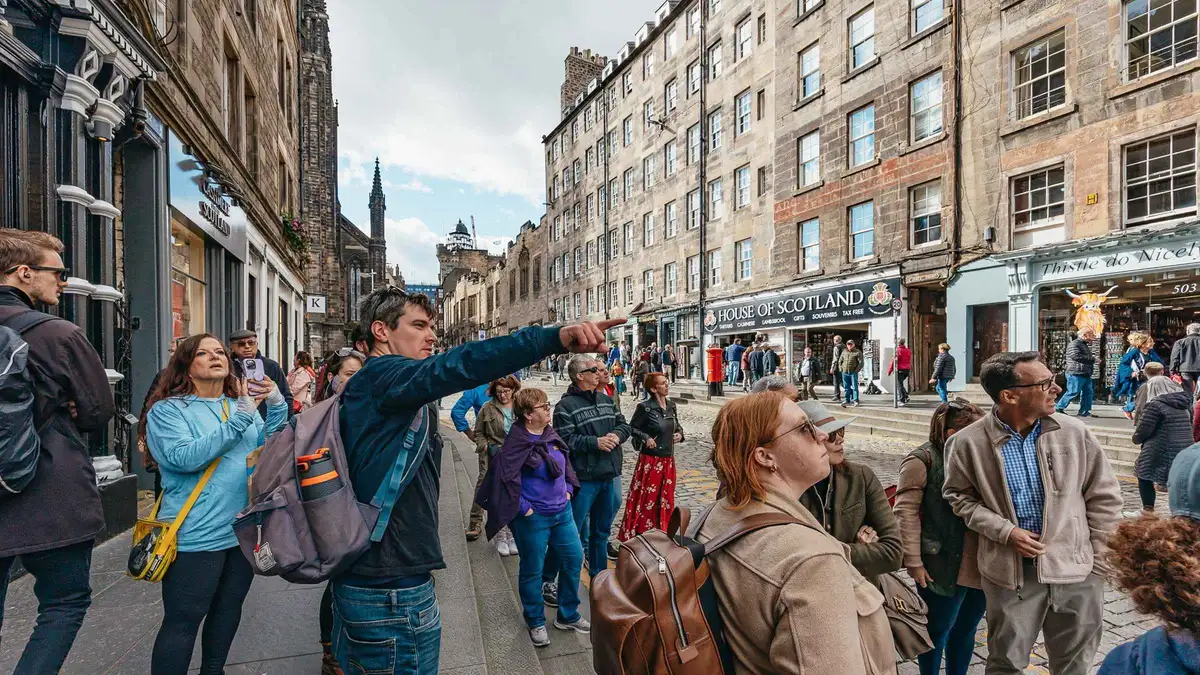 from £18
Edinburgh: Old Town History and Tales Walking Tour
Two hours through the UNESCO Old Town covering Mercat Cross, St Giles' and the Grassmarket, plus the Harry Potter locations. Ends in the centre near bars and transport; English only.
Check Availability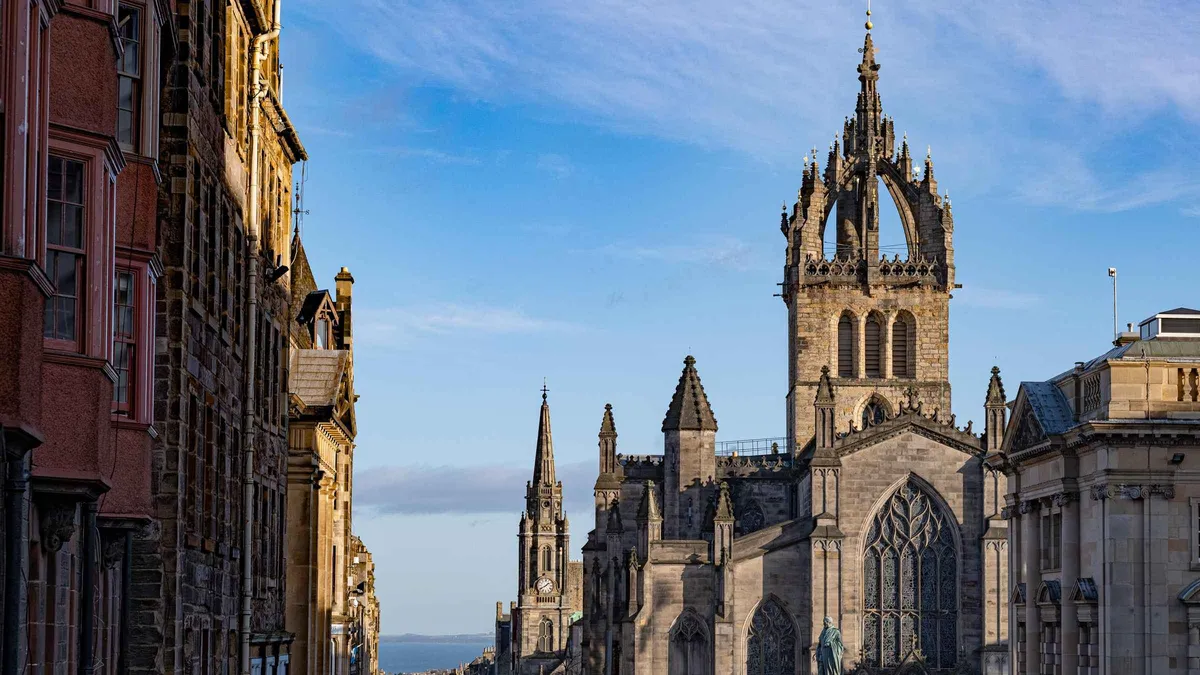 from £16
Edinburgh: Old Town History Walking Tour
The cheapest Old Town walk on the site, two hours past St Giles', Victoria Street and Greyfriars Kirkyard with the Greyfriars Bobby statue. Runs in four languages rather than English only.
Check Availability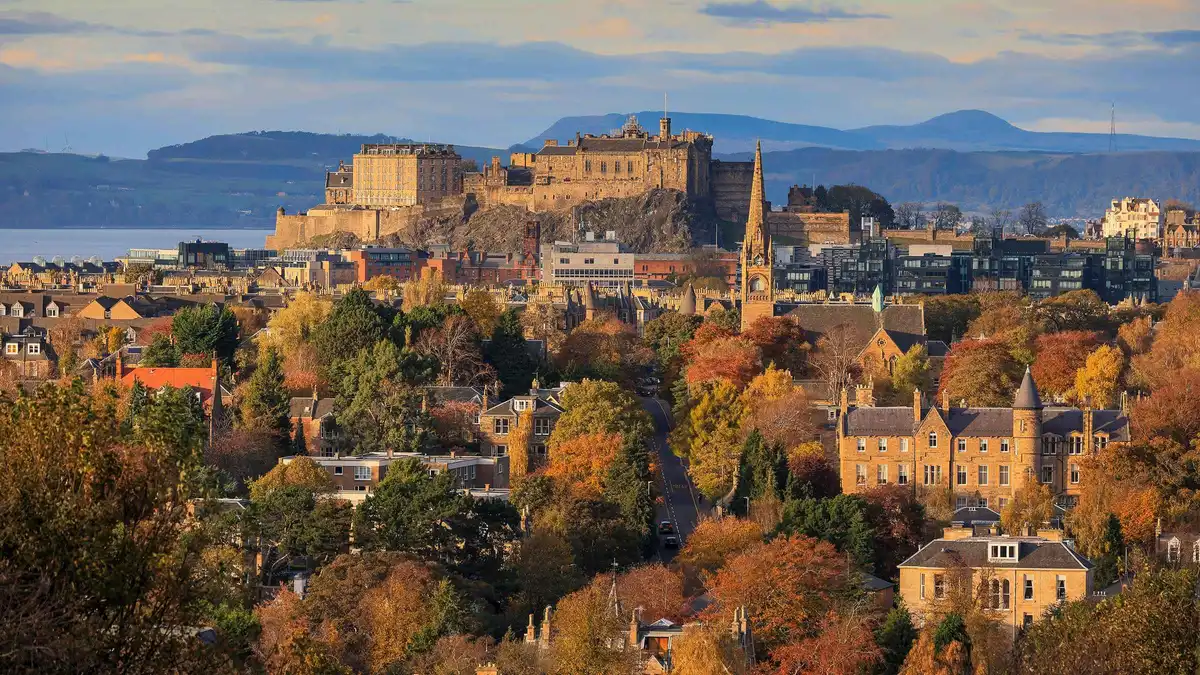 from £35
Edinburgh: 3-Hour Guided Walking Tour
Three hours and nineteen stops, from Usher Hall through the Grassmarket and Royal Mile to the Scott Monument, led by historians. You pass the castle from outside; no entry is included.
Check Availability from £25
Edinburgh: Port of Leith Distillery Tour & Tasting
Ninety minutes in the UK's first vertical distillery in Leith, tasting New Make spirit, port, sherry and Table Whisky. You fill and keep a miniature bottle of the new make.
Check AvailabilityPrices, ratings and details are the platform's own. Pound figures are the listed prices. The platform bills in your account's currency.
How Edinburgh is laid out, and why the areas feel so different
One ridge, one drained valley and one planned grid — the geography is the reason two neighbourhoods 400 metres apart can feel like different centuries.
UNESCO inscribed the Old and New Towns of Edinburgh together in 1995, as one property of 443 hectares, under criteria (ii) and (iv). Its own text describes what a visitor sees before anyone explains it: an organic medieval town running along a high ridge from the castle down to the Palace of Holyroodhouse, with a fishbone pattern of narrow closes, wynds and courts off the High Street and tall tenements on either side — and, on the glacial plain to the north, a planned neoclassical grid built between 1767 and 1890 as a collection of seven separate new towns. The two are joined across the Waverley valley by North Bridge and the Mound, and the valley itself was a loch until it was drained.
What the listing actually protects
Around 75% of the buildings inside the property are category A, B or C listed, and the setting is covered by a Skyline Policy adopted by City of Edinburgh Council that defines the key views across the city. Four conservation areas — Old Town, New Town, Dean Village and West End — between them cover the majority of the World Heritage property, which is why Dean Village appears in an inscription document at all. That is also the reason the streets in this guide have changed so little that the difference between the ridge and the grid still reads as a difference in town planning rather than in decoration.
One number is worth flagging because it is wrong in a lot of places, including on UNESCO's own page: the Brief Synthesis says the New Town covers 3,288 hectares while the same page's data block gives the whole inscribed property as 443 hectares. The 443 figure is the official property area. We print that one.
Why the ridge is loud and the grid is not
The Old Town's plan was defensive: everything crammed on to one narrow spine, which is why its pubs, its ghost walks and, in August, its Fringe venues are stacked on top of the flats above them. The New Town was built to escape exactly that, and it works — the grid disperses noise across wide streets and garden squares. Nothing about this is a judgement on either place.
It is the single most reliable predictor of whether you will sleep, and it is why the comparison table above leads with noise rather than with charm.
Walking between the areas: the minutes that are actually published
Most guides invent these numbers. Below, each figure is attributed — the tourist board's, the operator's, the conservation trust's — and where nobody publishes one we say it is our estimate from the distance.
Edinburgh's visitor core is roughly two miles end to end and one mile across, which means almost every pairing in this guide is a walk rather than a journey. What varies is the gradient.
| Between | How long | Whose figure | The catch |
|---|---|---|---|
| Princes Street to Stockbridge | About 15 minutes downhill | VisitScotland's own wording, quoted on our Stockbridge guide | It is downhill only in one direction |
| Queensferry Street to Dean Village | About 15 minutes down Bell's Brae | Our estimate from the distance; nobody official publishes one | The return climb out of the gorge is the steepest short walk in this guide |
| Dean Village to Stockbridge along the river | About 15 minutes | Our estimate, on the Water of Leith Walkway | The walkway is closed between Waulkmill Loan and Currie Kirk — far upstream, but check before a long route |
| Stockbridge to Leith along the river | About 1 hour 20 minutes for 3.5 miles | Water of Leith Conservation Trust | Ends at the Shore, which is the good end to arrive at |
| Roseburn to Stockbridge along the river | About 45 minutes for 2 miles | Water of Leith Conservation Trust | Enters the city from the west, past the modern art galleries |
| Top of the New Town to Leith down Leith Walk | About 40 minutes downhill | Our estimate from the distance | The tram runs the same line if the weather turns |
| Grassmarket to Victoria Street to George IV Bridge | About 5 minutes | Our estimate | One flight of steps at either end gets you on to Victoria Terrace |
The ridge sits about 40 metres above the valley floor at the Grassmarket end, so the same distance costs very different effort depending on which way you are going, and a fifteen-minute downhill walk is a twenty-five-minute uphill one.
The one area that is not a walk
Leith is the exception. Two miles north of the ridge is a real journey rather than a stroll, and the Royal Yacht Britannia's own site puts the port at 20 minutes from the city by tram or bus. Walking down is pleasant and mostly downhill; walking back at midnight after dinner is not, and that is what the tram is for.
The getting around page has the fares and the first and last times.
Moving between the areas by tram and bus: what it costs
Fares from lothianbuses.com/tickets/fares and edinburghtrams.com/tickets/ticket-options, both read on 30 August 2026 and both revised on 22 February 2026. Dollar figures are approximations at £1 = $1.36 and are never the charged price.
One fare structure covers both the buses and the trams inside the city zone, and for moving between the neighbourhoods on this page that is the only zone you will touch — the airport zone is the exception, and it is not a neighbourhood.
| Ticket | Adult | Child 5–15 | Approx. USD (adult) | What it is for |
|---|---|---|---|---|
| Single, bus or tram, city zone | £2.40 | £1.20 | $3.26 | One hop — the Old Town to Leith, say |
| Tap Tap Cap / Tap On Tap Off daily cap | £5.70 | — | $7.75 | The cheapest way to move all day, but only via the cap |
| City DAY ticket (trams and Lothian buses) | £6.00 | £3.00 | $8.16 | A paper equivalent, 30p dearer than the cap |
| Family DAY, 2 adults + 3 children | £13.00 | — | $17.68 | A family crossing between areas twice or more |
| Tram city day return | £4.60 | £2.30 | $6.26 | Out to Leith and back, nothing else |
| Family Day Tripper (tram) | £10.50 | — | $14.28 | The tram-only family option |
| City LATE, 18:00 to 04:30 | £5.50 | — | $7.48 | Dinner in Leith and the ride home |
The thing worth knowing before you tap is that capping is not automatic on a bus: Lothian's own fares page says a ticket bought on board with contactless is a single without capping, and the daily cap works only through Tap Tap Cap. Cash on board must be the exact fare; drivers give no change.
Which one we would buy
For a day spent inside the Old and New Towns, none of them — the walk is shorter than the wait. For a day that includes Leith, tap the same card on and off and let the £5.70 cap do the work, because two singles already cost £4.80 and the third journey is free. The weekly cap is £26.50 (about $36.04) if you are staying longer.
Full detail, including which services reach the airport at the city fare, is on the getting around page.
Market days decide your Saturday and your Sunday
The single most common mistake in Edinburgh itineraries, and it is one operator's fault for running two markets on opposite days.
Stockbridge Market runs on Saunders Street every Sunday, all year round, 10:00 to 16:00, and only on Sunday. The same operator runs the Grassmarket market on the central reservation of the Grassmarket every Saturday, all year round, 10:00 to 17:00, and only on Saturday. Both are free to enter, both publish their trader lists on the operator's own site, and the Stockbridge one has run since 2011 as the first of the family.
So the sequence is fixed for you. A Saturday belongs on the Old Town side — market in the square, Victoria Street above it, the closes and Greyfriars two minutes away. A Sunday belongs north of the valley: Stockbridge first for the market, then the riverside path west to Dean Village or east towards Leith. Reverse them and you spend both mornings looking at an empty street and wondering what the fuss was.
One caution about the historic market
Wikidata carries an entity called Stockbridge Market at St Stephen Place, which is the 1825 market arch, a different thing entirely from the modern Sunday market a few streets away on Saunders Street. The arch is worth two minutes and is not where the stalls are.
"Areas to avoid", "the poshest", "the hipster one": what we will and will not answer
Three of the four questions Google shows under this search are about status or safety. Here is the honest position on each, and what we checked before writing it.
Areas to avoid. City of Edinburgh Council publishes no visitor safety list, no no-go designation and no district crime ranking that a traveller could act on — we looked for one on 30 August 2026 and the Council's only district-level publications are conservation-area appraisals and the short-term let register. We are not going to convert somebody's residential postcode into a warning on the strength of a forum thread. What we can say usefully is narrower and true: none of the seven areas on this page is one a visitor is steered away from, the ones that get loud get loud rather than dangerous, and the practical Edinburgh risks are the ordinary city ones covered on the costs and money page.
The poshest, the hipster one, the nicest
These three are the same question wearing different clothes, and the answer is the same: they describe where people live, not where a visitor spends a day, and this is a visitor guide. If the label is what you are after, the New Town's garden squares and Stockbridge's Colonies are what people mean by the first, and Leith by the second — but the reason to go to Leith is that three starred kitchens stand within 400 metres of each other, and the reason to go to Stockbridge is a Sunday market and a river path. Those are facts you can plan around.
"Hipster" is not.
What the Council does publish about pressure
One genuine district-level fact exists and it is worth more than any ranking. The whole council area has been a short-term let control area since 5 September 2022, every host has needed a licence since 1 January 2025, and the secondary-letting licence fee scales from £653 (about $888) for one to three guests to £5,869 (about $7,982) at 21 or more. That, rather than any vague talk about over-tourism, is the concrete, sourceable reason the supply of flats in the central areas changed — and it is also why the Edinburgh costs page matters more than a neighbourhood ranking when you are choosing where to sleep.
The 5% visitor levy applies in every one of these areas
Because it comes up as an area question — it is not one. The rate is identical across the city.
From Friday 24 July 2026 the UK's first city-wide visitor levy applies to paid overnight stays in Edinburgh. It is 5% of the accommodation cost, capped at five consecutive nights, charged at the same rate every day of the year, and it applies to every paid overnight address in the council area — hotels, flats, guest houses, hostels, and to UK and Scottish residents as well as to overseas visitors. It has applied to advance bookings made since 1 October 2025 for stays on or after that date, so a room booked long before the scheme began still carries it.
What that means for choosing between neighbourhoods is simple: the levy is not a reason to prefer one district over another, because it is the same everywhere. Exemptions exist and are narrow, running to people who may not have a permanent or safe home and to holders of certain UK disability, incapacity and injury-related benefits, who must supply the exemption name, the benefit award letter, an invoice naming the exempted person and proof of payment. The arithmetic on a real bill is worked through on the Edinburgh costs page.
Which area to build the day around: the short version
A decision rather than a survey. One line each, in the order we would take them.
A first visit of one or two days: the Old Town, and nothing clever. The castle, the closes, St Giles', the National Museum and Greyfriars are all on or beside the ridge, four of them cost nothing, and the walk between them is measured in minutes. Book the two that sell out — the castle and the sealed closes — and let everything else be unplanned. The one-day itinerary sequences it by the hour.
A second day: cross the valley
The New Town in the morning for the two free national galleries and the grid itself, then downhill to Stockbridge and along the river to Dean Village — an afternoon that costs nothing but the coffee and is the best walking in the city. The two-day itinerary is built on exactly that shape.
A third day, or any evening: Leith
Leith is where the money you spend on dinner buys the most, and it is 20 minutes out on the tram. Do it as an evening rather than a day trip unless the yacht is on your list, in which case go at midday, see the yacht, and stay for the Shore. The three-day itinerary puts the port on the last afternoon for that reason.
Half an hour that is not a day: Victoria Street and Dean Village
Both are places rather than districts to spend time in. Victoria Street is 20 minutes at both levels and is on the way between the Grassmarket and the Royal Mile anyway. Dean Village is half an hour, is somebody's front garden, and is best treated as the middle of a river walk rather than as a destination you turn round at.
The Edinburgh area map: where each neighbourhood sits
The seven areas, coloured by which side of the Waverley valley they fall on. Pins are the Wikidata centroid of each area, or the middle of the street where the area is a street.
OpenStreetMap tiles. Straight-line pin distances are not walking routes — use the published walking minutes in the walking section instead.
Where to take the areas next
Four pages that turn this map into a plan.
Edinburgh in one day
One day is an Old Town day. This sequences the ridge around the two things that sell out, and puts the Grassmarket at the point in the afternoon when it is still quiet.
The ridge, hour by hourEdinburgh in three days
The long version of this page's decision section: ridge, then grid and river, then the port for the last afternoon and dinner.
All seven areas, in orderWhere to stay in Edinburgh
This page compares the areas as places to spend a day; that one compares them as places to sleep, with the 5% levy already in the arithmetic. The noise column here is the one to read alongside it.
Turning an area into an addressGetting around Edinburgh
Why plain contactless on a bus does not cap, what the £5.70 daily cap covers, and the tram's live status page — the things the fares table summarises.
Fares, caps and first and last timesDay trips from Edinburgh
Once the seven areas are walked, the next decision is whether to leave. That page ranks the destinations on hours out against hours actually spent there.
When the city is not the pointEdinburgh neighbourhoods: questions
How many neighbourhoods does Edinburgh have?
There is no single official count, and that is a real answer rather than a dodge: City of Edinburgh Council's open-data portal publishes "natural neighbourhoods" whose boundaries came out of a residents' consultation, Wikipedia's list of areas runs to dozens of names, and Scotland's tourist board groups the city into a shorter set of visitor areas. For a visitor the useful number is seven, which is what this guide covers — Old Town, New Town, Grassmarket, Victoria Street, Stockbridge, Dean Village and Leith. Everything else on those longer lists is residential.
Which area of Edinburgh should I visit first?
The ridge, on your first morning, before anything else. It holds the castle, the closes, St Giles' and the National Museum within a few minutes of each other, and the walk downhill from the esplanade is the one that makes the city's shape make sense. A two-hour history and tales walk at £18 (about $24.48) is the cheapest way to have it explained on the ground; the full Old Town guide has the free stops and the two things that need booking.
Are there areas of Edinburgh a visitor should avoid?
The Council publishes no visitor safety list and no district ranking a traveller could act on — we checked on 30 August 2026 and said so in the section on that question. None of the seven areas here is one visitors are steered away from. What varies is noise, not risk: the Grassmarket and the Old Town ridge are loud at the weekend and through August, and that is the thing worth planning around.
Which area sits where on the ridge?
The map on this page plots all seven, coloured by which side of the Waverley valley they fall on, with each pin linking to that area's own guide. The pins are Wikidata centroids, so the straight lines between them are shorter than the walk — the published walking minutes are in the walking section.
Which Edinburgh district is best for an evening out?
It depends on which evening you want. For pubs and volume, the Grassmarket is the loudest square in the city until closing time. For dinner, Leith has three Michelin-starred kitchens within 400 metres of each other and a port full of bars, about 20 minutes out on the tram — and the distillery tour and tasting at £25 (about $34) makes a good start to the night. The New Town sits between the two: restaurant volume, not pub volume.
Can I walk between Edinburgh's main districts?
All of them except Leith, comfortably. The tourist board puts Princes Street to Stockbridge at about 15 minutes downhill; Queensferry Street to Dean Village is about the same on our own estimate; and the whole Old Town ridge is a walk rather than a journey. Leith is two miles north and about 20 minutes by tram or bus — the fares table has what that costs.
Which areas are worth a walk but not a day?
Victoria Street and Dean Village. The first takes about 20 minutes end to end at both levels and sits on the route between the Grassmarket and the Royal Mile anyway; the second is a lived-in conservation area with no shop, no café and no visitor facility of any kind, best walked through on the way downstream to Stockbridge. Both are in the numbered list above with the timing we would give them.
The Areas of Edinburgh on Film
Three films that show the ground this page maps: how the city's districts fit together, what one of them looks like at street level, and how visitors weigh the areas against each other. Ids taken from our own verified harvest, not from memory.
Edinburgh's Map, Explained
The clearest explanation of why the ridge, the valley and the grid sit where they do — the geography behind every row of the table above.
Video: Daniel SteinerLocal's guide to Stockbridge, Edinburgh
One area at street level: Raeburn Place, St Stephen Street and the Sunday market, in the district this guide sends you to on a Sunday morning.
Video: Kakibot's GuidebookWhere to Stay in Edinburgh? 3 Best Areas
A visitor weighing the same areas against each other on the ground, which is a useful second opinion on the noise and distance columns here.
Video: Destination Well KnownVideos load from YouTube only when you press play.
Prices, hours and terms are set by the venue or operator and confirmed at checkout.
We may earn a commission if you book through one of our links, at no extra cost to you. Full affiliate disclosure